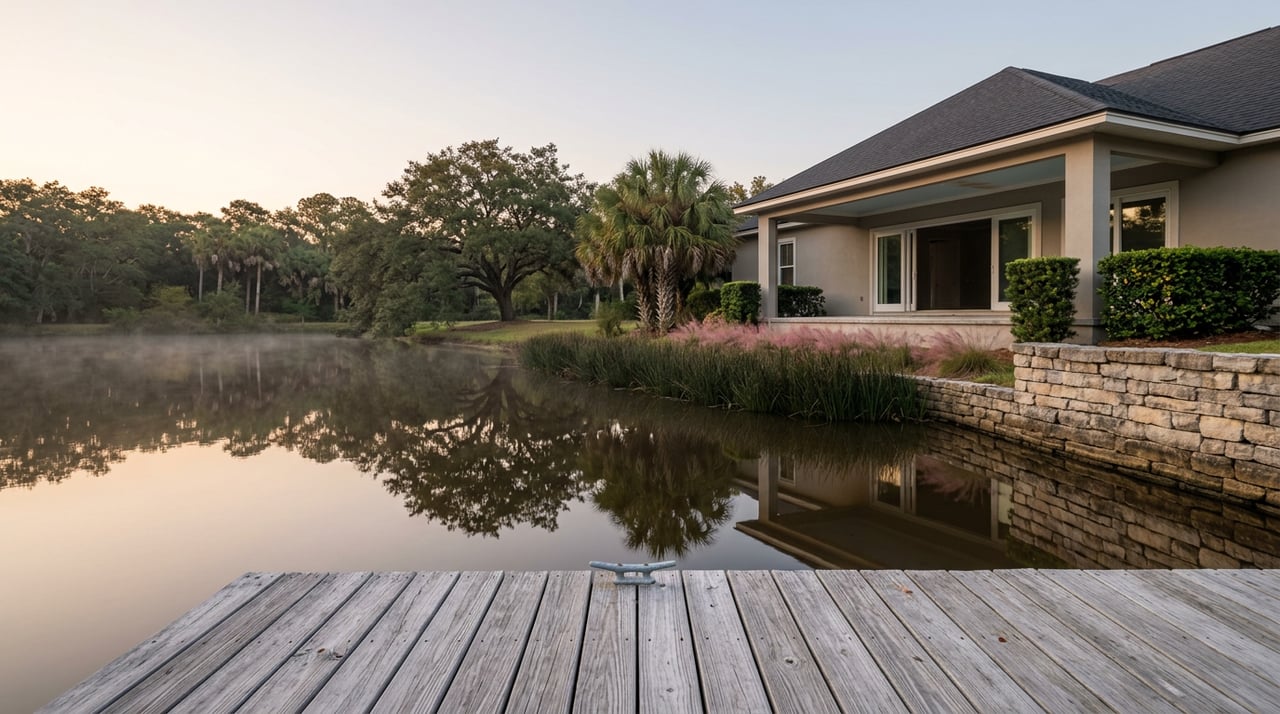
The footbridge over Oyster Lake doesn't look like anything in particular. It's a plain pedestrian crossing behind Stinky's Fish Camp, the kind of spot where visitors stop to snap a photo of the water and keep walking. Residents check it differently. After a hard rain, or after a few days of unusually high surf, the people who live on this stretch of 30A glance down at that channel before they glance at anything else, because what they're looking for isn't scenery. It's whether the lake has decided to let itself out.
That's the thing about Dune Allen that doesn't show up in a typical visitor's week. Every 30A community advertises proximity to the Gulf. Dune Allen is the only one where the more interesting water sits behind the dune line, not in front of it, and where the calendar that actually governs daily life runs on lake mechanics rather than tide charts.
The Lake Behind the Postcard
Coastal dune lakes are a genuinely rare landform, found in only a handful of places on the planet, and Dune Allen holds five of the fifteen that exist along the entire 30A corridor: Allen, Oyster, Stallworth, Campbell and Morris. Each one sits behind a narrow sand berm that separates fresh water from the Gulf by only a few feet. When enough rain or tidal pressure builds up, that berm breaches, water pours out toward the sea, and salt water pushes back in until the levels settle. Locals call it an outfall. For a day or two after one happens, the beach itself looks different, cut through by a channel that wasn't there the week before.
This isn't a once-a-summer novelty. It's a recurring hydraulic event that happens on a schedule tied to rainfall and storm pressure, which means the neighborhood's most distinctive feature isn't static scenery at all. It's infrastructure with a season, and residents who've been here a while read it the way farmers read weather.
A Bridge Built to Fail Correctly
The current footbridge over the Oyster Lake outfall has a longer backstory than its plain railings suggest. For years, the crossing relied on simple pilings that let water move naturally between lake and Gulf. In the 1960s, a culvert replaced those pilings, but it was installed in a way that kept the lake level artificially high rather than letting it drain the way it should have. That mismatch sat there for decades until the county finally corrected it in 2014, rebuilding the crossing with a design that lets the lake behave the way it's supposed to.
The channel underneath that bridge is engineered to a real spec: roughly twelve feet deep, about five hundred feet long, with sides sloped at a 3-to-1 ratio and more than two thousand square yards of turf reinforcement mat and earth anchors holding the banks in place. It's not decorative. When Hurricane Michael made landfall as a Category 4 storm sixty miles to the east, the vegetated slopes of that outfall held through the wind, surge and rainfall, protecting the homes nearby, the highway, and the bridge itself. None of that is visible on an ordinary Tuesday walk. It matters most in exactly the weeks Dune Allen is entering now.
The Actual Calendar
Ask a longtime resident when the lakes are "active" and you'll get a more specific answer than "summer." The pattern breaks down closer to this:
- July and August: Rainy season keeps the outfalls busy. Expect visible channels cutting the beach at Oyster and periodic culvert flow at Allen, with salinity climbing in the lakes as saltwater intrusion works its way in.
- September and October: Storm-driven breaches become the wildcard. This is the window when the engineering under the footbridge is actually doing its job rather than just sitting there, since tropical systems and their surge, not steady rain, are what tend to force the berm open.
- November through February: The lakes trend fresh again, mornings turn glassy and calm, a ride down the Timpoochee Trail is dry and cool, and Vue on 30A becomes the warmer alternative to the open-air beachfront spots further east.
- March through May: Birding season peaks, and the footbridge at Oyster along with Stallworth's protected shoreline draw photographers out early, before the wind picks up.
Right now, in mid-September, Dune Allen sits squarely in the second window. It's the stretch of the year when the lake system is least predictable and most worth paying attention to, which is exactly why residents check the bridge before they check the surf report.
What a September Week Looks Like Here
A typical week still runs through the same handful of places, just with an extra layer of awareness laid on top.
The Timpoochee Trail starts at Mile 0 right at the entrance to Topsail Hill Preserve State Park, and it's the spine of a Dune Allen morning. Riders pass Stallworth Lake within the first mile and a half, then Stinky's Fish Camp and Allen Lake shortly after, before the trail crosses over to the Gulf side near the Dune Allen Regional Beach Access around Mile 2 and back across near Oyster Lake. The full trail runs 18.5 miles to Inlet Beach, named for Chief Timpoochee Kinnard, a Euchee leader who lived along Choctawhatchee Bay in the early 1800s, but most residents never ride the whole thing in one go. They use the western mile and a half as a loop, watching the lakes along the way the same way someone else might check a garden.
Coffee usually means a stop at Kith & Kin, which opened in August 2020 on the west side of Highway 30A right by the Topsail Hill Preserve entrance and built its reputation on the idea that the coffee is really an excuse to run into your neighbors. Sunday still belongs to Stinky's Fish Camp, sitting directly on Allen Lake, where brunch runs from 10 a.m. to 3 p.m. with live music from 11 to 2. It's been that way long enough that it barely counts as an event anymore. It's just what Sunday is.
None of this changes in September. What changes is the undercurrent. A resident heading out for that same bike ride after a heavy overnight rain will glance at the Oyster Lake crossing first, not because anything dramatic is guaranteed, but because this is the month it's most likely to happen.
The Rhythm Only Residents Learn
Visitors treat Dune Allen's lakes as scenery, something to photograph from the footbridge and move past. Residents treat them as a system with a memory, one that has already been tested by a Category 4 hurricane and rebuilt once when the original engineering got it wrong. Living behind that dune line, even for a season, means learning to read water the way people elsewhere read a sky before a storm. That's not a skill anyone needs on a beach vacation. It's one that comes from actually being here long enough to notice the pattern repeat.
If you already call Dune Allen home, September is a good month to walk out to that footbridge after the next hard rain and see for yourself what the engineering is built to handle. And if you're weighing what it actually means to hold a piece of one of the rarest coastal ecosystems on the planet, from a market perspective as much as a lifestyle one, the team at Emerald Dunes Realty knows this stretch of 30A block by block, lake by lake, season by season. Start Your Coastal Home Search whenever you're ready to talk specifics.